How to Tell How You Are Related in a Family Tree
In this article we share the steps you demand to have to help determine the genetic relationships of your Deoxyribonucleic acid matches.
 You've taken a DNA exam. The day finally arrives when yous go a notification in your email: your results are ready! Y'all eagerly log into your account and begin navigating your genetic heritage. Eventually, possibly later on viewing your ethnicity admixture results, or looking at different genetic traits, you make your manner over to your lucifer list. In that location are hundreds of people who share DNA with you—your genetic cousins. Some of the close ones might be familiar. There is your cousin, and another lucifer has a surname that sounds familiar from family conversations. And still, virtually of the others are complete strangers. Who are these people? Why don't they have surnames you recognize? How closely related are they? To find out, piece of work through the following half dozen steps to determine how you are related to a genetic cousin.
1. Build Your Family Tree
In order to make up one's mind how you might exist related to a genetic cousin in your match list, information technology's important to outset build your own family unit tree. This tree provides a reference for comparison against your genetic cousin'due south family unit tree. Offset with yourself, your parents, your grandparents and other known relatives. Explore the research of others equally a inkling for your own research efforts. Finally, seek certificate evidence to identify likely ancestors, support proposed generational connections, and document important events in your family tree. Since autosomal DNA evidence is about effective for revealing relationships inside the last six to viii generations of ancestry, we recommend building out your family tree at least five to half dozen generations wherever possible. If this is not possible due to brick walls in your family tree, don't worry. The DNA assay tips we offer here tin assistance yous overcome those challenges.
After tracing your family back, consider besides tracing the descendants of your ancestors for a few generations. Determining who the siblings, nieces, nephews and other collateral relatives of your ancestors married tin can assist you recognize other surnames associated with your family. Maybe your genetic cousin volition carry one of those surnames. Perchance they deport the surname of your great-gramps'due south brother-in-constabulary or son-in-police. Descendancy research might help you tie into the published trees of other genetic cousins.
In one case you have synthetic a family tree based on document prove and family information, attach it to your DNA test results. This can generate hints regarding your potential relationships to genetic cousins giving clues regarding your shared ancestors, locations and surnames.
2. Explore the Family Copse of Your Genetic Cousins
Afterward familiarizing yourself with your own family unit tree, information technology's fourth dimension to compare against your genetic cousin'southward family unit tree. Some genetic cousins attach family copse to their Dna test results. These trees can generate hints if you both written report descent from the same ancestors. If you accept taken the step to include some of your collateral relatives in your family tree, new technologies similar ThruLines and The Theory of Family unit Relativity can aid to identify likely mutual ancestors even if yous do not both study your common ancestors in your respective family copse. Sometimes, copse attached to DNA exam results are very pocket-sized, including only a few generations. Other times, the fastened family trees are private, or a genetic cousin may non have attached a family tree to their test results. Consider reaching out to your genetic cousin and requesting data on their family unit tree. If your genetic cousin does not respond, effort to build a family tree for them using the clues they provide in their username or contour in conjunction with public tape indexes or traditional genealogical research. By building out the family unit tree of your match, you can often detect shared surnames, locations or even ancestors in your respective family trees. Just don't stop there! Right at present, you just have a hypothesis. It's important to confirm that your proposed genealogical relationship aligns with the genetic evidence! Even if you can't identify proposed common ancestors, the next steps can help y'all translate probable levels of relationship.
3. Determine How Many CentiMorgans You Share
The closeness of a genetic human relationship is estimated based on the number of centiMorgans (cM) you share with a match. CentiMorgans are a measurement of the likelihood of recombination in autosomal Dna over the class of a generation.
Autosomal Deoxyribonucleic acid is composed of 22 pairs of chromosomes that you inherit from your begetter and mother. Y'all get one set from mom and one corresponding gear up from dad. Before DNA gets passed on to the adjacent generation, your maternal chromosomes and paternal chromosomes line up and commutation genetic material in a process called recombination. This procedure results in chunks or segments of Deoxyribonucleic acid getting passed on to you from your more distant ancestors. On any given chromosome, you lot might inherit chunks of Deoxyribonucleic acid from one grandparent, the other grandparent, or a combination of segments from both grandparents. Copies of these segments of DNA get passed downwards from generation to generation resulting in the distribution and dispersion of your antecedent's genetic legacy. When you share a segment of Dna with a genetic cousin, information technology ways that a copy of the Dna from a common ancestor got passed downward over multiple generations, through multiple recombination events. That segment survived the genetic lottery to become to y'all and your genetic cousin—a pretty amazing feat! Every bit a full general dominion, closer genealogical relatives share more segments of Deoxyribonucleic acid and share segments with larger centimorgan values considering in that location accept been fewer opportunities for the segments to become cleaved up through the process of recombination. Therefore, closer relatives typically share more centimorgans than more distant relatives.
In the following list, nosotros draw how to find the number of centimorgans at each of the major Deoxyribonucleic acid testing companies:
four. Explore Probable Relationship Levels Based on Total Shared Centimorgans
Some amounts of shared centimorgans are just observed at specific relationship levels. In other cases, an corporeality of shared centimorgans may be possible for several relationship levels but is nevertheless more likely for a sure relationship level than for others.
There are several resources to aid you make up one's mind the most likely level of human relationship based on the number of shared centimorgans between yous and your genetic cousin. If you accept tested at AncestryDNA, you can click on the small "i" circle right next to the report of your shared DNA with each genetic cousin in your lucifer list. This volition requite you a tabular array describing the probable probability levels for each level of relationship. These probabilities announced to come up from Ancestry's own database analysis. If you have tested elsewhere, or if yous want a second reference point, visit DNA Painter's "The Shared cM Projection 3.0 tool v4,". Here you blazon in the total number of shared centimorgans (to the nearest whole number), and it volition generate a table of probabilities for different relationship levels. If you lot are working with 23andMe data and merely accept the percent of shared DNA, Deoxyribonucleic acid Painter will also have a percentage input. These probabilities are from the AncestryDNA Matching Whitepaper based on simulated data. The DNA Painter Calculator too cross references the Shared cM Project—a project compiling existent data from user-provided submissions of amounts of shared Deoxyribonucleic acid for known levels of relationship. The Shared cM Project gives a good idea of the ranges of observed shared Deoxyribonucleic acid for specific human relationship levels.
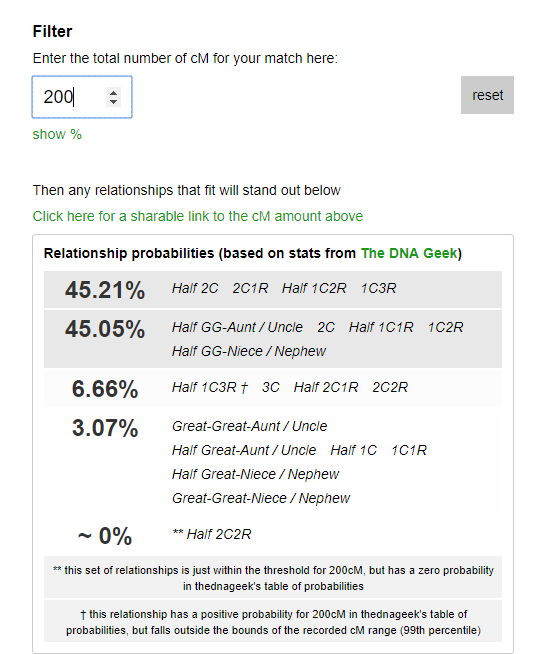
Screenshot of DNA Painter tool.
v. Consider Genetically Equivalent Relationships
The corporeality of DNA you share with a genetic cousin is dependent on the number of generations (or recombination opportunities) between you and your cousin. It is also dependent on the number of ancestors y'all share in common. Because of these variables, some relationships are genetically equivalent. For example, a 2d cousin is someone with whom you share common great-grandparents. A first cousin twice removed is the grandchild of your first cousin (or the cousin of your grandmother). Second cousins and commencement cousins twice removed are both expected to share similar amounts of DNA because both levels of human relationship include six generational steps. In well-nigh cases, two genetic cousins will be related through two common ancestors: an ancestral couple. When two individuals just share one ancestor, the amount of Dna they are expected to share in common is cutting in half. When they share more than two ancestors, the amount of DNA shared can increase. Either state of affairs can lead to additional genetically equivalent relationships. Half siblings (2 generational steps with one mutual antecedent) share about 25 percent of their Dna. An aunt and her nephew (3 generational steps with two mutual ancestors) also share approximately 25 percent of their Dna. A grandparent and a grandchild (two generational steps with one mutual ancestor—the grandparent) too share approximately 25 percentage of their Dna. If one of your parents has an identical twin, so your outset cousin who is the child of your parent's twin might too share about 25 percentage of their Dna with you lot. Finally, double first cousins (4 generational steps with two pairs of mutual ancestors) also share approximately 25 pct of their Deoxyribonucleic acid.
When you are evaluating the DNA you share with a relative, don't be alarmed when your dandy-aunt shows upward as a proposed first cousin. Those relationships are genetically equivalent (four generational steps with two common ancestors). It is up to y'all to consider the additional data at your fingertips such every bit the ages and family trees of each private to navigate equivalent relationship levels. A good guideline is to consider approximately 25 years of historic period deviation equally a generation.
6. Compare Your Hypothesis to the Genetic Evidence
Good chore so far! You've navigated your family tree and your genetic cousin'south family tree and identified a relationship hypothesis. Yous've explored the shared DNA, identified likely human relationship levels and navigated equivalent relationships. Now it'south fourth dimension to pull information technology all together for your conclusion. Does the proposed genealogical relationship fit with the estimated genetic human relationship? If yous have identified your genetic cousin equally a probable 2d cousin, is a 2nd cousin level of relationship the most likely level of relationship given your amount of shared DNA? If non, is a second cousin level of relationship still reasonably likely (does it have a percent probability college than 10-15%), is information technology possible at all? Even if your proposed human relationship is the most probable, are in that location other human relationship levels which are also reasonably likely? Be sure to avoid any confirmation bias. You might be tempted to see what you want to see and merely ignore conflicting evidence. Just because a second cousin human relationship is possible does not hateful that it is proven, particularly if a second cousin once removed (genetically equivalent to a half second cousin human relationship) is also possible or significantly more probable.
If your proposed genealogical relationship (as identified in the first two steps) is not the most likely level of human relationship given the genetic evidence (equally identified in steps three through five), put your investigation on hold and echo this process for some of your more afar genetic cousins. Are at that place others who descend from the aforementioned ancestors and share more appropriate amounts of shared DNA given their proposed relationships? Practise you have genetic connections to collateral relatives of each member of the proposed ancestral couple? Does your genetic cousin share matches who are collateral relatives to each fellow member of the proposed ancestral couple? Exploring these questions can help you determine if you lot and your genetic cousin are in fact one-half-relatives, if there is a case of misattributed parentage along one of your ancestral lines, or information technology may help you confirm that y'all are actually related at the proposed relationship level, simply but happen to share low amounts of shared Deoxyribonucleic acid.
Build your family tree. Explore family unit trees for your matches and if possible, propose hypothesized relationships. Determine the amount of Dna you share with your cousin. Evaluate the probabilities of different relationship levels given your proposed Deoxyribonucleic acid. Explore genetically equivalent relationships. Finally, correlate the traditional and genetic prove and determine if they align. If necessary, repeat the procedure for other genetic cousins to ensure the accuracy of your research. By post-obit these steps, y'all can identify relationships to unknown genetic cousins, confirm your relationships to known ones, and guard against the possibility of misattributed parentage in your family tree.
Are you struggling to make sense of an unexpected result in your DNA exam? Legacy Tree Genealogists has experienced researchers who would love to help you consider both the genetic and documentary bear witness to resolve your research questions. Contact united states of america today for a free quote!
[1] Jonny Perl, "Shared cM tool v4," DNA Painter, (https://dnapainter.com/tools/sharedcmv4, accessed April 2019).
[two] Catherine Ball, et al., AncestryDNA Matching White Paper Discovering genetic matches across a massive, expanding genetic database, published online 31 March 2016, (https://www.ancestry.com/deoxyribonucleic acid/resources/whitePaper/AncestryDNA-Matching-White-Paper.pdf: accessed April 2019), figure v.2, p. 32
[three] Blaine Bettinger, "Baronial 2017 Update to the Shared cM Projection," The Genetic Genealogist, 26 August 2017, (https://thegeneticgenealogist.com/2017/08/26/august-2017-update-to-the-shared-cm-project//: accessed April 2019).
Subscribe for weekly posts
- Bio
- Latest Posts

From a young age, Paul Woodbury savage in beloved with genealogy research. To pursue his passion for this field, he studied genetics and family history at Brigham Immature Academy. To aid in his desire to share his knowledge with others, he has too received a masters degree in instructional design and educational applied science from the Academy of Utah. Paul currently works as a DNA team lead at Legacy Tree Genealogists where he has helped to solve hundreds of genetic genealogy cases. In addition to genetic genealogy, Paul specializes in French, Castilian, and Scandinavian research and regularly presents on topics for these areas. is a graduate of Brigham Young University, where he studied genetics and family history. He specializes in genetic genealogy (Dna research), French, Castilian, Swedish and Norwegian genealogy research.
Source: https://www.legacytree.com/blog/determine-genetic-relationships
0 Response to "How to Tell How You Are Related in a Family Tree"
Post a Comment